


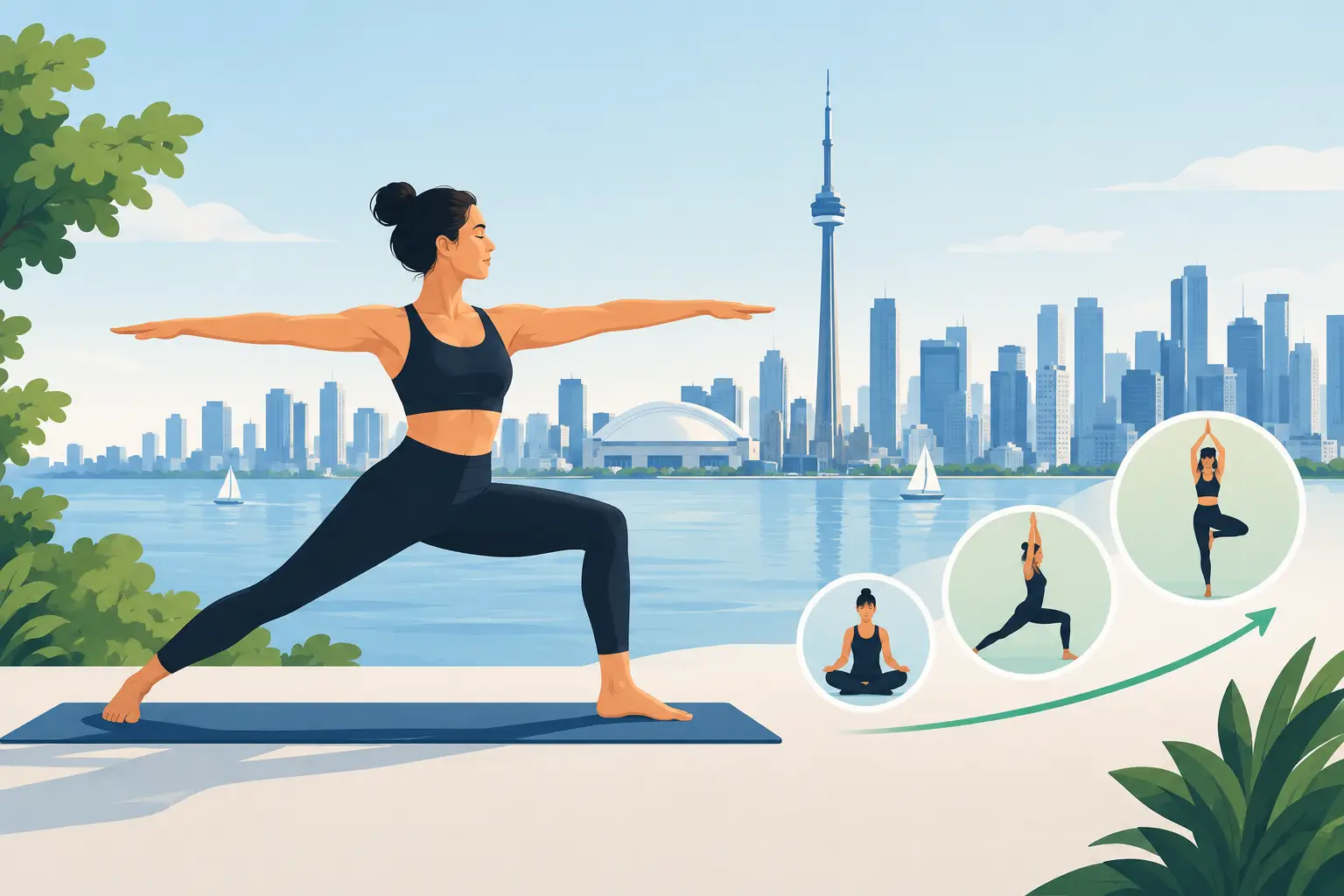
A runner notices that the familiar pull through the hips no longer appears at kilometre 12. A hockey player finds a deeper, calmer breath between shifts. A lifter gains the shoulder control to press without compensating through the low back. These are the kinds of Toronto athlete yoga results that matter: not a dramatic overnight change, but a body that feels more capable, more recoverable, and better connected to the demands of sport.
For athletes, yoga is not a replacement for strength training, skill practice, conditioning, or the advice of a regulated health professional when pain is involved. It is a valuable complement. Practised consistently and taught with care, yoga can help fill in the spaces that a sport-specific program may leave behind: mobility with control, down-regulation after intense effort, balanced strength, and the ability to pay attention to what the body is actually communicating.
What Toronto Athlete Yoga Results Can Look Like
Athletic progress is often measured in visible numbers: pace, weight on the bar, minutes played, power output, rankings. Yoga offers results that can be less immediate to quantify, yet highly practical. You may notice that your warm-up takes less time, your range of motion feels more reliable, or you recover your breath more quickly after a hard session. You may also become more aware of a small restriction before it becomes the kind of compensation that disrupts training.
Flexibility is part of the picture, but it is not the whole story. Passive range without stability does not necessarily make an athlete more resilient. A well-taught practice asks you to create strength and control inside a range of motion. In a lunge, for example, the work is not simply to push further into the hip. It is to organize the feet, legs, pelvis, and breath so the position is supported.
That distinction is especially useful for athletes who are already mobile. Dancers, swimmers, and some field-sport athletes may not need more range everywhere. They may benefit more from steadiness, proprioception, and thoughtful strength through their existing range. Meanwhile, cyclists, runners, desk-working professionals, and strength athletes often appreciate the opportunity to restore motion in the hips, thoracic spine, ankles, and shoulders without turning every recovery day into another high-intensity workout.
Recovery Is a Training Skill
Hard training creates stress by design. Adaptation happens when the body has enough capacity to recover from it. While yoga cannot erase the demands of an overloaded training schedule, slower practices can support a deliberate transition out of effort mode.
Restorative yoga, longer-held supported shapes, and breath-led movement give many athletes a chance to shift attention away from output and toward recovery. This matters for the person who is excellent at pushing but less practised at stopping. A quiet class can feel surprisingly challenging at first, particularly when the mind is still replaying a game, a race, or a demanding workday.
The result is not that you will never feel sore or fatigued. Soreness can be a normal response to training, and fatigue sometimes calls for more sleep, more fuel, or a revised program rather than another class. But learning to recognize the difference between productive effort and accumulated strain can support wiser decisions. Some days call for a strong, steady flow. Other days call for props, breath, and permission to do less.
Breath and focus under pressure
Athletes often hear cues such as “stay calm” or “focus on the next play,” but those skills are easier to access when they have been practised in a lower-stakes setting. Yoga invites that practice. Balancing postures, challenging transitions, and sustained holds all create moments where attention can scatter. Returning to breath is a simple, repeatable way of coming back to the present task.
That is not a promise of instant mental toughness. Competition pressure is complex, and each sport has its own psychological demands. Still, a regular yoga practice can offer a useful rehearsal: notice tension, soften what is unnecessary, and stay engaged with what is in front of you.
Choosing the Right Practice for Your Sport
The best yoga class for an athlete depends on the season, current training load, experience level, and goals. Someone in the final weeks before a race may need a different practice than they would in an off-season focused on building capacity. A newcomer returning from an injury may need more individual guidance than a seasoned practitioner who is ready for a stronger format.
For athletes who want a structured, energizing practice, Ashtanga-based classes can build consistency, body awareness, and full-body strength. Mysore practice can be particularly meaningful for students who value individualized pacing and instruction within a shared room. Rather than trying to match someone else’s range or rhythm, each practitioner works with the sequence in a way that meets them where they are.
Strength-focused yoga and Pilates can be helpful when the goal is trunk stability, hip control, and integrated movement. Pilates is not simply a lighter workout. When taught with precision, it can ask a great deal of the deep stabilizing systems that help athletes transfer force efficiently and move with more control.
Restorative yoga is often the better choice when your nervous system feels overloaded, sleep has been poor, or your training week is unusually demanding. Choosing restorative work is not falling behind. It is responding to the training cycle you actually have, rather than the one you wish your body could sustain indefinitely.
At Breathe Yoga Studio, experienced teachers can help students choose a class that complements the rest of their week, whether that means a strong practice, a steady beginner foundation, or a quieter recovery-focused session.
Why Consistency Beats the Occasional Big Stretch
One long class after months away can feel satisfying, but it rarely creates lasting change. The most meaningful results usually come from manageable frequency. For many athletes, two yoga or Pilates sessions per week is enough to begin building familiarity with the movements and to notice patterns in recovery. Others may pair one stronger class with one restorative session, especially during heavy training blocks.
Consistency also protects against the common mistake of treating yoga as a corrective punishment for a tight body. If you only attend when something hurts, the practice can become associated with frustration. A more sustainable approach is to make yoga part of regular athletic care, much like warming up, hydrating, or planning a lighter day after a demanding one.
There is a trade-off to consider. Adding classes to an already packed schedule can become another source of stress. If you are training six or seven days a week, the answer may not be to add two vigorous yoga sessions. It may be to replace one lower-value workout, choose a shorter practice, or make recovery your priority for a period of time. More is not always better. The right amount is the amount that leaves you better able to return to your sport.
Tracking Progress Beyond the Mirror
Athletes tend to stay motivated when progress is observable. Rather than judging yoga by whether you can touch your toes or achieve an advanced posture, watch for functional changes. Can you sit more comfortably after a long ride? Do your shoulders feel more stable overhead? Are you able to sleep more soundly after evening training? Do you feel less rushed in transitions and more aware of your form?
Keep the observations specific and tied to your own sport. A tennis player might track shoulder comfort during serving. A runner might notice cadence and hip fatigue late in a run. A hockey player might pay attention to ankle mobility and recovery between practices. These details provide a more useful measure than comparing your practice to the person on the next mat.
If pain is sharp, persistent, worsening, or accompanied by weakness, swelling, numbness, or instability, pause and seek appropriate clinical guidance. Yoga teachers can offer intelligent movement options, but they do not replace diagnosis or rehabilitation care. Honest communication about injuries and training demands helps a teacher support you safely.
The most rewarding athletic practice is one you can continue to enjoy. Start with the class that fits your body and your calendar now, arrive without needing to prove anything, and give the quieter changes room to take root.
