


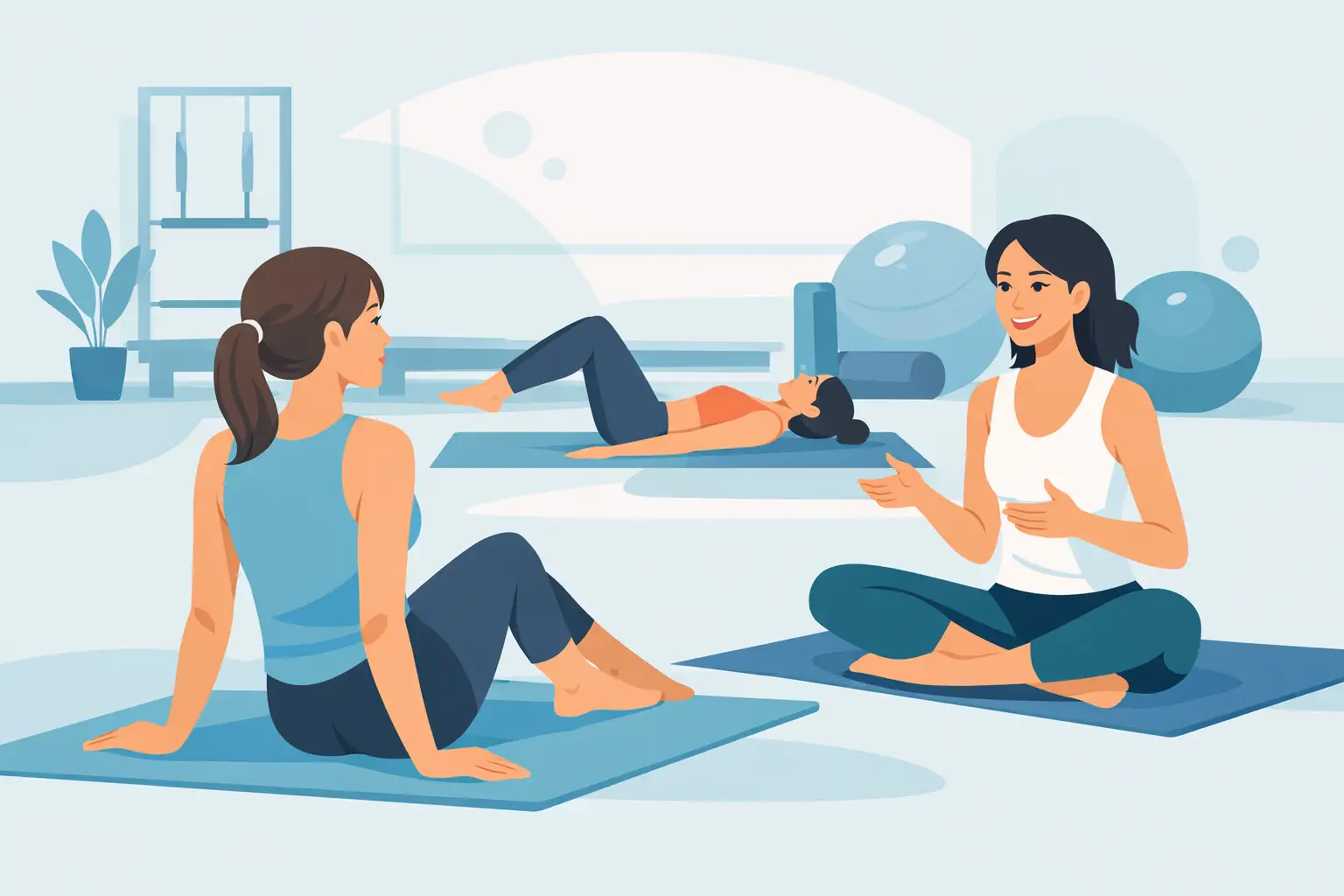
Your first Pilates class may begin more quietly than you expect: a mat, a few carefully chosen props, and an instructor asking you to notice how you are breathing before you start moving. If you are wondering what to expect at a first Pilates class, the short answer is focused, intelligent movement that can feel both gentle and surprisingly challenging.
Pilates is not about pushing through discomfort or keeping up with the fastest person in the room. It is a practice of building awareness, strength, mobility, and control from the inside out. Whether you are returning to movement, balancing a busy Toronto schedule, or looking for a meaningful complement to yoga and strength training, your first class is simply a place to begin.
What to Expect at Your First Pilates Class
Most Pilates classes follow a clear, supportive arc. You will settle in, warm up your body, work through intentional strength and mobility exercises, then finish with a few moments to reset. The details vary depending on whether you are attending a mat-based class or an equipment-based class, as well as the teacher’s training and class focus. But the central principles remain consistent: breath, alignment, concentration, control, and balanced strength.
At the beginning, your teacher may ask whether you are new to Pilates, living with an injury, pregnant or postpartum, or managing any movement concerns. This is useful information, not a test. Sharing it allows the instructor to offer options that better support your body that day.
You can also expect detailed cues. Rather than being asked to complete dozens of repetitions quickly, you may hear guidance about the position of your ribs, pelvis, shoulders, or feet. A teacher might invite you to soften your jaw, broaden across your collarbones, or exhale as you engage your deep abdominal muscles. These small adjustments are where much of Pilates happens.
The pace is deliberate, not passive
Pilates can look calm from the outside, especially in a beginner class. Then you hold a bridge, move one leg with control, or attempt a slow roll-up and discover muscles you did not realize were working. That is normal.
The goal is not to make every exercise look effortless on day one. It is to learn how your body organizes movement. A slower pace gives you time to feel the difference between gripping with your neck or hip flexors and finding steadier support through your centre.
You may sweat, particularly in a strength-focused class, but Pilates is not measured by how exhausted you are at the end. Many people leave feeling worked, longer through the spine, and more settled in their nervous system. Others feel pleasantly humbled. Both responses are part of learning something new.
Mat Pilates and equipment classes feel different
Before booking, check whether the class is held on a mat or uses Pilates equipment. Neither is inherently better. The best first choice depends on your experience, goals, and comfort level.
Mat Pilates uses body weight, gravity, and simple props such as bands, balls, or rings to create challenge and feedback. It can be an excellent entry point because it helps you understand foundational shapes and breathing patterns. It can also be demanding. Without spring resistance to guide you, stabilizing the body can require a great deal of attention.
Equipment-based Pilates often uses springs to create resistance and assistance. Springs can make certain movements more accessible while also adding substantial strength work as your skill develops. If you are completely new, a smaller class or introductory session can be especially helpful, since the equipment needs to be set up correctly and adjusted for your body.
If you are unsure, choose a class clearly identified as beginner-friendly and let the teacher know it is your first visit. At Breathe Yoga Studio, experienced teachers create space for questions and offer modifications so newcomers can learn with confidence rather than feeling rushed to perform.
What to wear and bring
Wear clothing that lets you bend, reach, and lie down comfortably. Leggings, joggers, shorts that stay in place, and a fitted or semi-fitted top are all practical choices. Very loose shirts can slide up during inversions or abdominal work, while restrictive waistbands can make breathing feel less natural.
Most studios ask participants to wear grip socks for hygiene and stability, particularly for equipment classes. If you do not have a pair, ask in advance whether they are required or available at the studio. Bring water, though you may not need as much as you would for a heated or high-intensity workout.
For a mat class, the studio may provide mats and props, or you may be welcome to bring your own. Arrive 10 to 15 minutes early for your first session. That little buffer matters: you can complete any registration details, meet your instructor, and settle into the room without carrying the stress of a late arrival into your practice.
You do not need a “Pilates body” or prior flexibility
One of the most persistent myths about Pilates is that you need to be strong, flexible, slim, coordinated, or already familiar with exercise to belong in class. You do not. Pilates is a method for developing capacity, not a reward for having it already.
A skilled instructor can adapt an exercise by changing the range of motion, adding support, reducing resistance, or offering a different version altogether. For example, a full roll-up may become a smaller curl with bent knees. A plank may be done with hands elevated or knees down. These are not lesser choices. They are thoughtful ways to train the intended muscles while respecting where you are now.
That said, modifications are not always necessary. If you feel well and the movement is clear, your teacher may encourage you to explore a little more challenge. The most useful rule is simple: look for muscular effort, not sharp pain, numbness, dizziness, or a sense that you are forcing a position. Stop and speak to your instructor if something does not feel right.
Expect a learning curve with the breath
Pilates breathing can feel unfamiliar at first. You may be asked to breathe into the sides and back of the ribcage, or to exhale during the effort phase of an exercise. This is not about perfect breathing technique. It is a tool that can help you avoid holding tension, support trunk stability, and stay connected to the movement.
If coordinating breath and movement feels like rubbing your stomach while patting your head, you are in good company. Keep breathing naturally and let the finer details develop over time. Your first class is for orientation, not mastery.
How sore will you be afterward?
You may notice mild muscle soreness one or two days later, particularly through the abdominals, glutes, inner thighs, upper back, or smaller stabilizing muscles around the hips and shoulders. This is especially common if Pilates asks your body to work in a new way.
Soreness should feel manageable. Extreme pain, joint pain, or symptoms that persist are signals to pause and seek appropriate guidance. Recovery supports progress, so plan for water, regular meals, sleep, and gentle movement after class. A restorative yoga practice, an easy walk, or simply a few unhurried stretches can all complement Pilates well.
The frequency that works best varies. Some people benefit from one weekly class as a consistent movement anchor; others enjoy two or three sessions alongside walking, yoga, or strength training. More is not automatically better. The right rhythm is one you can sustain while giving your body time to adapt.
Let your first class be information, not a verdict
It is easy to walk into a new class and decide you are either “good” or “bad” at it within the first ten minutes. Try not to make that judgement. Pilates rewards repetition because the same exercises reveal new layers of coordination, strength, and ease as your awareness grows.
After class, notice what you learned. Perhaps your shoulders tend to creep toward your ears, your balance changes from one side to the other, or your breath becomes shallow when an exercise gets difficult. These observations are valuable. They are the beginning of a more responsive relationship with your body.
Come as you are, ask the question you need to ask, and take the version of each exercise that serves you. With consistent practice, the quiet focus of a first Pilates class can become a steady source of strength, mobility, and calm in the rest of your week.
