


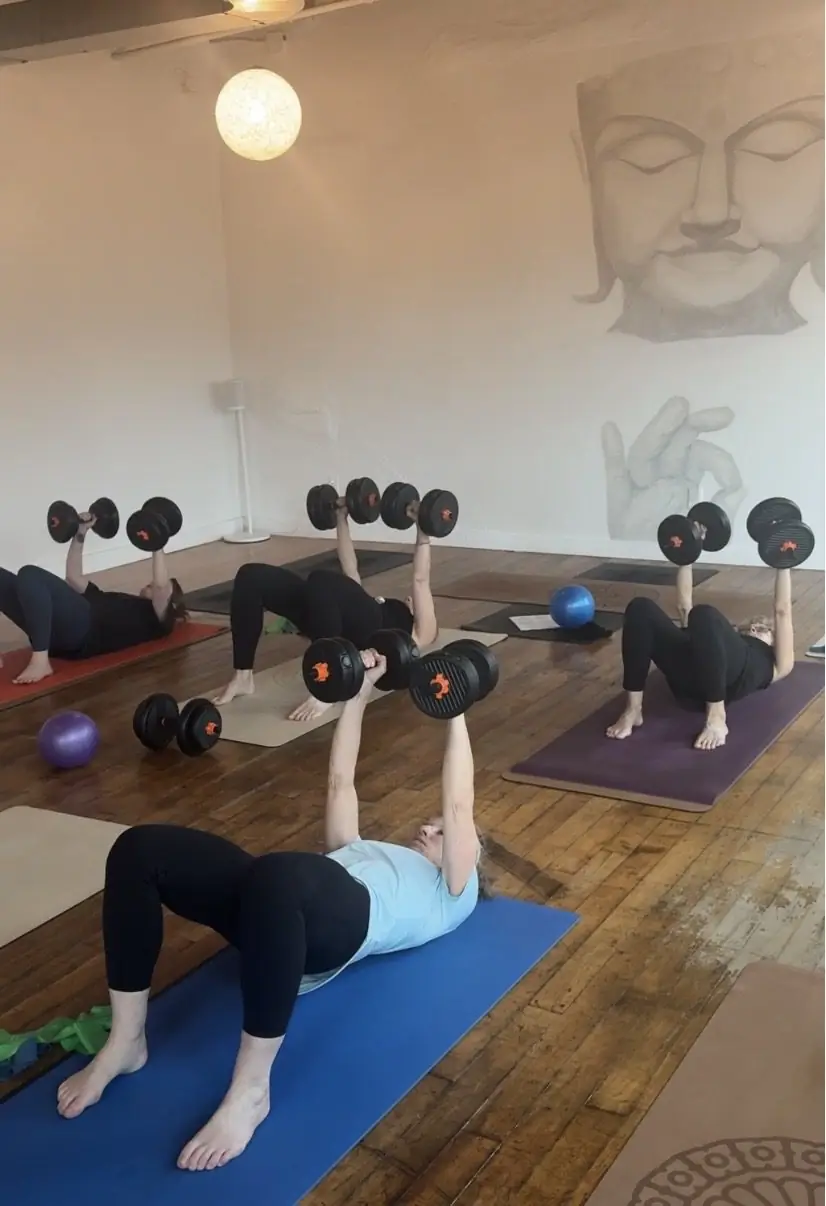
You should not have to choose between the energy of a group class and the attention you need to move well. Small group strength training creates room for both: purposeful coaching, manageable class sizes and a shared commitment to feeling stronger in daily life. Whether you are returning to movement after time away, supporting a yoga practice or ready to progress beyond the same home workout, the right setting can make strength feel more approachable.
Strength is not reserved for a certain fitness level, body type or training history. It is a practical resource for carrying groceries, sitting comfortably at your desk, climbing stairs, improving balance and continuing to do the activities that make you feel like yourself. The work matters, but so does how you are guided through it.
What makes small group strength training different?
A smaller class changes the quality of attention in the room. Rather than trying to keep up with a large crowd or follow a generic plan on your own, you have an experienced teacher watching how you move, offering clear options and helping you understand the purpose behind each exercise.
That does not mean every class is slow or overly cautious. It means the challenge is better matched to you. One person may be learning a hip hinge with support while another adds load, range or tempo to the same movement pattern. Both are building strength, and neither has to force a version of the exercise that is not right for their body that day.
This format also brings welcome accountability. Familiar faces, regular class times and a teacher who notices your progress can make consistency feel less like a test of willpower. You are part of a community, while still receiving individual care.
Strength training is more than lifting heavier
Building strength can include weights, resistance bands, bodyweight work, Pilates-informed conditioning and controlled tempo exercises. The most useful program is not always the one with the heaviest dumbbells. It is one that helps you develop stability, coordination and confidence while progressively asking your muscles to adapt.
A thoughtful class often works with foundational movement patterns: squatting, hinging, pushing, pulling, carrying, rotating and resisting rotation. These patterns show up beyond the studio. Learning to brace through your trunk while you carry a bag, for example, can support a more resilient back. Improving hip and leg strength can make walking, cycling or getting up from the floor feel easier.
Mobility belongs in the conversation, too. Flexibility without control does not always translate into better movement. Strength training can help you access and own a range of motion, particularly through the hips, shoulders and spine. For yoga practitioners, this can create more support in standing poses, transitions and arm balances. For people who spend much of the day seated, it can be a grounded way to reconnect with their body.
Why coaching and progression matter
It is tempting to judge a workout by how exhausted you feel afterward. But sustainable progress is usually quieter than that. It comes from practising movements with good technique, adding challenge at an appropriate pace and giving your body adequate recovery.
In a well-led small group, a teacher can offer a regression when an exercise does not feel stable, or a progression when you are ready for more. You may adjust your stance, reduce the range of motion, choose a lighter load or slow down. On another day, you might increase resistance, try a single-leg variation or spend longer under tension. These are not signs that you are behind or ahead. They are tools for meeting your body honestly.
This kind of responsive coaching is especially valuable if you are new to strength work, managing an old injury or navigating changes related to stress, sleep, pregnancy, perimenopause or a busy work season. A group class cannot replace individualized medical care or rehabilitation when that is needed. Still, skilled instruction can help you make sensible choices and stay connected to movement rather than stepping away from it altogether.
The goal is capacity, not punishment
The best strength practice leaves you feeling capable. You may work hard and experience normal muscle fatigue, but the aim is not to override pain, chase soreness or prove anything to the room. It is to gradually expand what your body can do.
That distinction matters for long-term wellbeing. When training becomes punishment, it is difficult to sustain. When it becomes a practice of care, it can support energy, mood, posture, sleep and confidence alongside physical strength.
What to expect in your first class
Your first session may begin with a warm-up that prepares your joints and nervous system for the movements ahead. Expect breathing, gentle mobility and activation work rather than jumping straight into intense exercise. From there, the class may move through a few focused strength patterns with enough time to learn and repeat them.
You do not need to arrive already fit. You do not need to know the names of every exercise. Wear clothing you can move in, bring water and let the teacher know about any injuries, limitations or concerns before class begins. Clear communication helps your instructor offer more relevant options from the start.
It can also help to release the expectation that you must get everything right immediately. Strength is a skill. Your first few classes are a chance to become familiar with the equipment, the pace and the feeling of working with intention. The confidence comes through repetition.
How often should you train?
For many people, two strength-focused sessions each week is a realistic and effective starting point. It provides enough repetition to practise key movements and enough space for recovery. If you are beginning from a lower activity level, one consistent session is still meaningful. If you already have an established training base, three sessions may suit you well, depending on intensity, goals and recovery.
The right frequency depends on your schedule, sleep, stress levels and the other movement you enjoy. A runner may benefit from a different weekly rhythm than someone who practises restorative yoga or spends long days at a computer. More is not automatically better. The most supportive plan is one you can maintain without feeling depleted.
Pairing strength work with yoga or Pilates can be particularly valuable. Yoga may support body awareness, breath and mobility. Pilates can build deep core control and precision. Strength-focused classes add progressive resistance and load-bearing work. Together, they can create a varied movement practice that supports both challenge and recovery.
Choosing a class that feels right
Look for teachers who explain movements clearly, welcome questions and provide options without making anyone feel singled out. A good class has structure, but it also leaves room for real bodies and real days. You should feel encouraged to work with focus, not pressured to ignore warning signs.
Consider the practical details as well. Convenient class times, a welcoming atmosphere and a format you genuinely enjoy all affect whether you will return. In a busy city, the studio close to home or work can become a valuable pause in your week – a place to put your phone down, move with purpose and reconnect with your own capacity.
At Breathe Yoga Studio in Toronto’s Junction, strength-focused movement sits within a broader approach to wellness that values mobility, recovery and nervous system care alongside physical challenge. That wider lens can be especially helpful when your goal is not simply to exercise more, but to feel better supported in your everyday life.
Give yourself time to notice the changes
Early progress is not always visible in the mirror. You may first notice that you can hold a plank with steadier breath, lift a suitcase with less hesitation or move through a long workday with fewer aches. You may feel more at home in your body and more willing to try something that once felt intimidating.
Start with the class you can return to next week. Let the work be gradual, let good coaching guide you, and allow strength to become one more way you care for yourself.
