


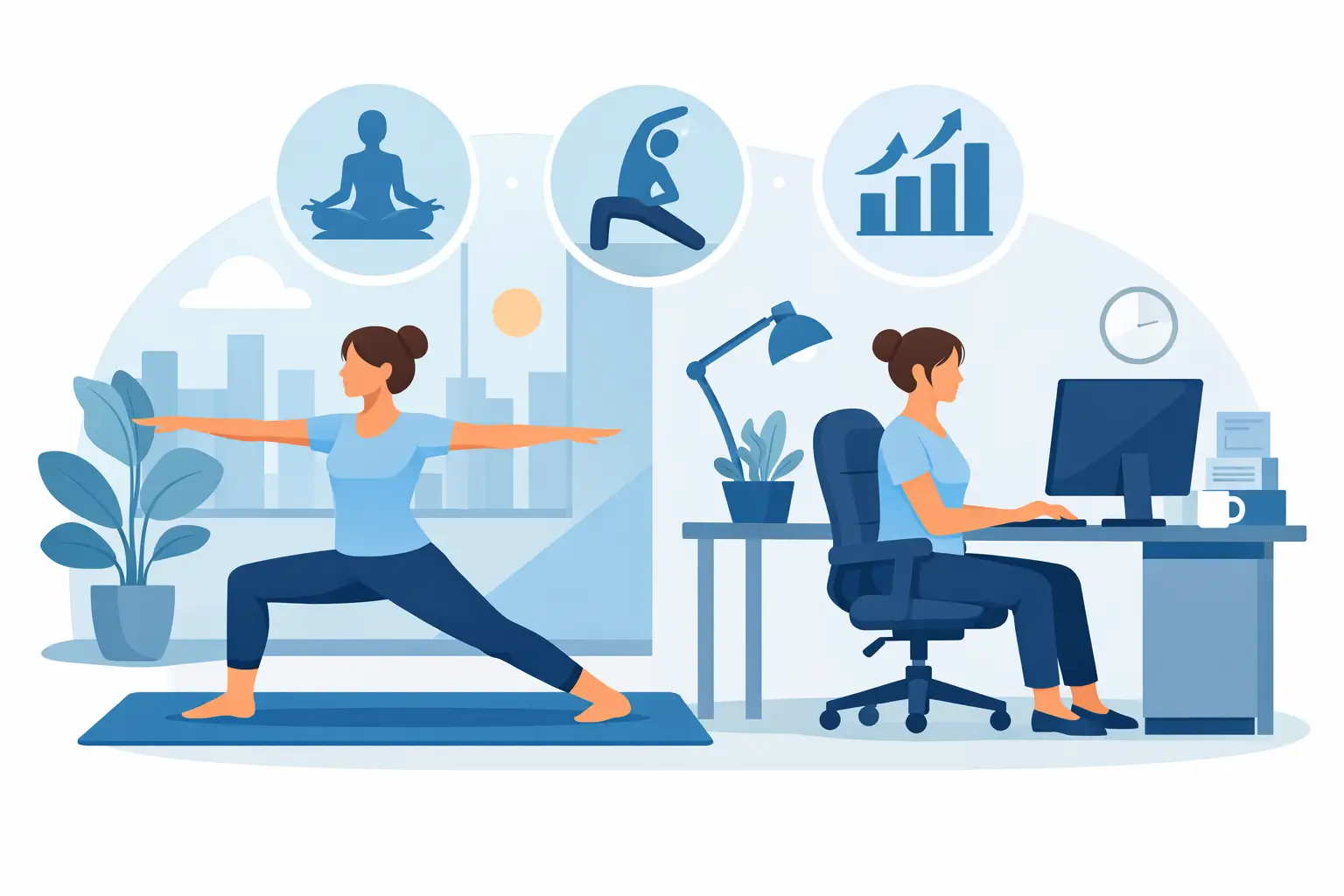
Your shoulders inch towards your ears during a deadline. Your hips feel locked after a morning of calls. By 3 p.m., even a good chair cannot quite rescue your back. Yoga for desk workers is not about forcing a deep stretch between meetings. It is a practical way to counter long periods of stillness, rebuild body awareness, and create a calmer transition out of work mode.
The goal is not perfect posture all day. Human bodies are built to change positions, not hold one ideal shape for eight hours. A supportive yoga practice gives you more movement options: strength for sitting and standing, mobility where you feel restricted, and breathing practices that help your nervous system shift out of constant urgency.
Why desk work shows up in the body
Sitting itself is not the enemy. The challenge is doing almost anything for too long. Hours at a laptop can leave the hip flexors and chest feeling shortened, while the upper back, glutes, and deep abdominal muscles do less of the work they are designed to do. Add a forward-reaching posture, a phone held below eye level, and the pressure of a busy day, and stiffness can begin to feel inevitable.
Desk work also affects how you breathe. When you are concentrating, it is common to take shallow breaths or hold your breath without noticing. That pattern can amplify tension through the neck, jaw, ribs, and shoulders. A well-sequenced yoga class addresses more than tight muscles. It invites fuller breathing, steadier attention, and a sense of arriving back in your body.
There is an important distinction here: yoga can support comfort, mobility, and resilience, but it is not a substitute for medical assessment. Persistent pain, numbness, weakness, recent injury, or symptoms that worsen with movement deserve guidance from an appropriate health-care professional. In class, a skilled teacher can help you modify positions, but pain is never something to push through.
Yoga for desk workers starts with movement breaks
A 60-minute class can be deeply restorative, yet your body benefits just as much from brief, regular movement throughout the day. Think of these breaks as changing the channel, not fixing a problem. Two or three minutes is enough to interrupt one position and remind your joints that they can move.
Try standing beside your desk, feet hip-width apart. Reach both arms overhead as you inhale, then lower them slowly as you exhale. Repeat a few times without forcing the range. Next, interlace your hands behind your back, or hold a strap or towel between them, and gently broaden across the collarbones. Keep your ribs soft rather than thrusting the chest forward.
For the upper back, place your hands on your desk and step back until your torso forms a long diagonal. Bend your knees as much as you need. Press the floor away, lengthen from your hips through your hands, and let your head rest naturally between your upper arms. This can feel especially welcome after keyboard work, but it should never produce pinching in the shoulders.
Then give the hips some attention. A low lunge with one knee down can create space at the front of the hip, particularly if you spend much of the day seated. Instead of sinking as far as possible, lightly engage your lower belly and glute on the kneeling side. The sensation should be manageable and spacious, not sharp. Switch sides and take a few slow breaths.
These movements are simple on purpose. The most useful desk routine is the one you will actually do before your body feels completely depleted.
Build strength, not just flexibility
Many people arrive at yoga hoping to stretch tight hamstrings or release their shoulders. Those are reasonable goals, but flexibility alone may not change how your body feels at work. A more balanced practice includes strength and control, especially through the legs, glutes, core, upper back, and shoulders.
Chair Pose, for example, asks the legs and trunk to support you while your arms reach overhead. Warrior II builds leg endurance and encourages an upright, open chest. Plank variations can strengthen the shoulders and trunk when they are adapted to your current capacity. Even a slow, mindful transition from hands and knees into a modified plank can be more valuable than holding a shape that compromises your wrists or lower back.
This is where class choice matters. Restorative yoga can be an oasis after a demanding week, using props and longer holds to support recovery. A strength-focused yoga or Pilates class may better serve someone who feels unstable, fatigued, or disconnected from their core. A steady beginner practice can offer the clearest foundation if you are returning after time away. The best option depends on your goals, energy, history of injury, and what helps you stay consistent.
Use breath to leave work at work
The physical side of desk work is only part of the picture. A full inbox and back-to-back conversations can keep the nervous system on alert long after the laptop closes. Yoga offers a useful boundary ritual: a few minutes in which your breath, movement, and attention all have one place to go.
Begin with a comfortable seated or reclined position. Let your exhale become slightly longer than your inhale, without straining or counting aggressively. You might inhale gently through the nose and exhale slowly through the nose for five rounds. Notice whether your jaw is clenched or your shoulders are working harder than necessary.
This is not about achieving instant calm. Some days, slowing down can make you more aware of how stressed you feel. That awareness is still valuable. It gives you information, and with practice, it can make it easier to choose what you need next: a walk, a nourishing meal, a more active class, rest, or a conversation with someone supportive.
A realistic weekly rhythm
Consistency does not require daily hour-long practices. For many busy professionals, one or two studio classes each week, paired with short workday resets, creates a sustainable rhythm. A stronger class can help rebuild capacity; a slower class can help recovery catch up. If your schedule changes week to week, choose the class that meets your energy rather than treating every session as a test.
At Breathe Yoga Studio, students can explore a range of practices, from accessible beginner classes and Pilates to restorative yoga and more established Ashtanga or Mysore practice. Small-class attention can be particularly useful when desk discomfort has made you cautious about returning to movement. Let your teacher know about recurring areas of tension, any injuries, and what you hope to feel differently in your day.
You can also make your workstation a little more movement-friendly. Position your screen so you are not continually looking down, keep frequently used items within easy reach, and stand or walk during calls when it is practical. These changes help, but they do not replace varied movement. An ergonomic setup is a support, not a reason to remain still for longer.
Let progress be felt, not forced
The signs that yoga is helping may be quieter than touching your toes. You may notice that you take a breath before replying to a stressful message, that your neck feels less guarded on the commute home, or that you can sit through a meeting without needing to constantly shift. You may also discover that a pose feels different from one day to the next. That is normal, not failure.
Approach your practice with curiosity rather than correction. Move often, ask for support when you need it, and choose classes that make you feel more capable in your own body. Your desk may remain part of your day, but it does not have to dictate how you feel in it.
