


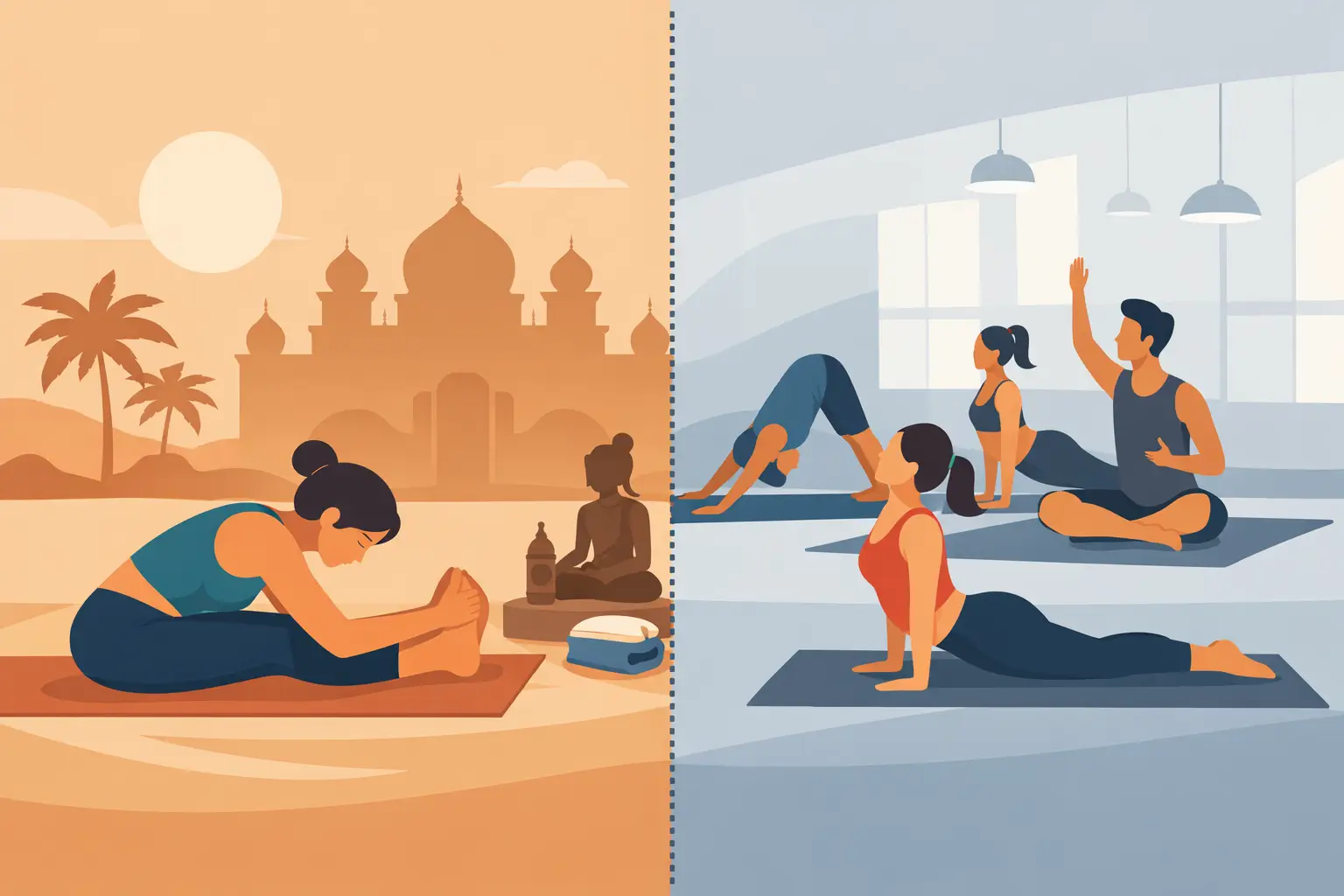
A room of students moving through different stages of the same sequence can look unfamiliar at first. One person may be standing in sun salutations, another may be seated in a forward fold, and someone else may be resting quietly. That is often a Mysore room. When people ask about Mysore vs led Ashtanga, they are usually deciding between two meaningful ways to experience the same tradition – one highly individual and one practiced together.
Neither format is more advanced, more disciplined, or more authentic than the other. They offer different kinds of support. The right choice depends on where you are in your practice, how you learn, what your body needs, and whether you are looking for shared rhythm or more individual guidance.
Mysore vs Led Ashtanga: the essential difference
Ashtanga yoga is traditionally taught through a set sequence of postures linked by breath and movement. Over time, students learn that sequence in a progressive way. Both Mysore and led classes draw from this method, but the teaching environment is distinct.
In a led Ashtanga class, the teacher guides the room through the sequence together. They call the postures, offer breathing counts, set the pace, and provide cues for transitions. Everyone generally moves in unison, although experienced teachers will always encourage appropriate modifications and rest.
In a Mysore-style class, students practise at their own pace within a shared room. The teacher works with individuals rather than leading every posture aloud. You may receive a new posture when you are ready, a helpful adjustment, or a quieter variation that supports your current capacity. Despite the name, Mysore is not a silent, unsupported self-practice. It is a guided learning environment with considerable personal attention.
The format takes its name from Mysore, India, where this style of teaching became closely associated with the Ashtanga tradition. Its purpose is practical: students can learn the sequence gradually and build a practice that meets them where they are.
What a led Ashtanga class feels like
A led class has a clear collective energy. The teacher’s voice carries the practice from opening chant or centring through sun salutations, standing postures, seated work, and closing sequence. For many students, that steady rhythm is grounding. You do not need to remember what comes next or decide when to move on. You simply breathe, listen, and practise.
This structure can be especially supportive when you are new to Ashtanga. The repetition helps you understand the architecture of the sequence: where the body warms up, how postures build on one another, and when to slow down. It can also be a welcome reset for established practitioners who spend much of their week practising independently.
Led classes are not only for beginners. Practising in unison can sharpen concentration and reveal habits that are easier to miss when you set your own pace. The shared breath and movement can create a powerful sense of community, particularly after a long workday when making decisions feels like one more task.
There are trade-offs. The class pace may occasionally feel quicker or slower than your natural rhythm. If you are recovering from illness, working with an injury, menstruating, pregnant, or simply low on energy, you may need to modify, rest, or leave certain postures aside. A skilled teacher makes room for those choices. Ashtanga is a framework, not a test of endurance.
Led practice may suit you if you want structure
Consider a led class if you are learning the foundations of the sequence, enjoy clear verbal instruction, or find motivation in practising alongside others. It can also suit busy Toronto professionals who want to arrive, follow a thoughtful class plan, and leave feeling more settled without having to hold the sequence in memory.
A led class is often a useful place to become familiar with Sanskrit posture names, breath counts, and the steady internal focus that makes Ashtanga more than a physical workout.
What a Mysore class feels like
Mysore practice is often described as self-paced, but that phrase can make it sound solitary. In reality, a well-held Mysore room is attentive and connected. Students arrive within a designated practice window, unroll their mats, and begin. Some may practise for 30 minutes, while others stay longer as their sequence develops. The room is quiet enough to hear your breath, yet alive with the reassuring presence of others doing their own work.
The teacher observes, offers guidance, and helps each student learn step by step. If you only know sun salutations and a few standing postures, that is where you begin. You do not need to arrive knowing the full Primary Series. A beginner’s Mysore practice can be simple, short, and exceptionally well supported.
This gradual approach is one of Mysore’s greatest strengths. Rather than trying to absorb an entire sequence in a single class, you learn a manageable amount, repeat it, and add on when it is appropriate. That repetition can build confidence, body awareness, and a more honest relationship with progress. Some days your practice feels spacious. On others, a shorter practice is exactly right.
Individual attention changes the learning process
Because the teacher is not calling every pose for the whole room, they can respond to the person in front of them. That may mean offering a prop, changing a transition, refining a standing posture, or asking you to stop at a specific point in the sequence. The aim is not to push you further. It is to help you practise with steadiness and care.
For students managing tight hips, wrist sensitivity, back concerns, stress, or fluctuating energy, this can be invaluable. Individualized instruction makes it easier to develop strength and mobility without ignoring the signals your body is giving you.
Mysore does ask something different of you: patience. You will gradually memorize your sequence, and the practice may feel less externally entertaining than a fast-moving group class. For some people, that is precisely its medicine. For others, particularly at the beginning, the open format can feel intimidating. A welcoming teacher and a short first practice make a significant difference.
Choosing the class that supports your life right now
The choice does not need to be permanent. Many students benefit from both formats, using led classes to reinforce rhythm and Mysore sessions to receive more personal guidance. Your preference may also shift with the season, your schedule, or your health.
If you are completely new to yoga, do not assume that Mysore is off limits. A beginner-friendly Mysore class can be one of the gentlest ways to enter Ashtanga because you are not expected to keep up with a room full of people. At the same time, a led foundational class may give you useful orientation if you feel more comfortable with explicit direction.
If you already have an Ashtanga background, Mysore can help deepen consistency and refine details that are hard to address in a group count. But led practice still has value. It reconnects you with the cadence of the series and the collective discipline of practising together.
The best question is not, “Which class will make me better fastest?” Try asking, “Which setting will help me return to my mat with curiosity and consistency?” Sustainable practice is built less through force than through a format you can genuinely return to.
How to prepare for your first class
Arrive a few minutes early and let the teacher know whether you are new to yoga, new to Ashtanga, or working with an injury or health consideration. Wear clothing that allows you to move comfortably, and avoid a heavy meal immediately beforehand. You do not need special flexibility, yoga experience, or knowledge of Sanskrit to begin.
For a first Mysore class, expect to be taught a short, accessible portion of the sequence. Your teacher will tell you when to stop. For a first led class, give yourself permission to pause, take child’s pose, or modify when needed. Rest is part of intelligent practice, not a disruption to it.
At Breathe Yoga Studio, Ashtanga teaching is held with the belief that focused practice and genuine care belong together. Whether you are drawn to the shared momentum of a led class or the individualized pace of Mysore, choose the room where you feel supported enough to listen closely, practise honestly, and keep coming back.
