


A wobbly balance pose, an aching low back after a desk-heavy day, or a sense that your shoulders take over in every plank can all point to the same missing piece: coordinated core support. Learning how to improve core stability is not about bracing harder or chasing a flatter stomach. It is about helping your body create steady, adaptable support while you breathe, move, lift, twist, and rest.
A stable core makes everyday movement feel less effortful. It can help you feel more grounded in standing yoga postures, more controlled in Pilates, and more confident carrying groceries, climbing stairs, or returning to exercise after time away. The goal is not tension for tension’s sake. It is strength you can access without holding your breath or losing ease.
What core stability really means
Your core is more than your abdominal muscles. It is a responsive system that includes the deep abdominal wall, back muscles, diaphragm, pelvic floor, hips, and the muscles around your rib cage. These areas work together to manage pressure and transfer force through the body.
Core strength is often described as the ability to create force. Core stability is the ability to maintain useful alignment and control while force changes around you. Think of holding a steady tabletop position while reaching one arm forward, or staying tall through your spine as you step into a lunge. Your body is not frozen. It is making small, intelligent adjustments.
This distinction matters because endless crunches may strengthen certain muscles without teaching the coordination needed for daily life. A thoughtful yoga or Pilates practice asks for something more complete: breath, alignment, awareness, and gradual challenge.
How to improve core stability without over-bracing
Many people respond to instability by gripping their abdominals as tightly as possible. While a short, strong brace has its place, constant gripping can make breathing shallow, create unnecessary tension in the hips or jaw, and leave you feeling more rigid than supported.
Start with your breath. In a comfortable position, place your hands around the lower ribs. Inhale and allow the ribs to widen gently in all directions. As you exhale, feel the lower belly softly draw inward and the pelvic floor respond with a subtle lift. There should be effort, but not a dramatic squeeze.
This is the quality you are looking for in movement: a steady exhale, a gently organized trunk, and enough freedom to keep the neck, shoulders, and face relaxed. If you cannot breathe smoothly, the exercise is probably too demanding right now.
Build control before adding intensity
The most effective core work often looks quieter than expected. Begin with movements that let you notice whether your spine, pelvis, and ribs remain organized while your limbs move. Supine marching, heel slides, dead bug variations, and bird dog are useful examples when performed slowly.
In each exercise, move only as far as you can without your low back arching dramatically, your ribs flaring upward, or your pelvis rocking side to side. A smaller range with clear control will build more useful stability than a larger range completed with compensation.
For example, in a dead bug variation, lie on your back with knees bent above your hips and arms reaching toward the ceiling. Exhale to settle your ribs and lower belly, then slowly tap one heel toward the floor. If your back lifts or your breath gets stuck, reduce the range. Over time, that controlled range can grow.
Use yoga poses as stability practice
Yoga offers excellent opportunities to train core stability because the body is constantly adapting to shifts in balance, load, and position. The key is to approach familiar poses with attention rather than rushing through them.
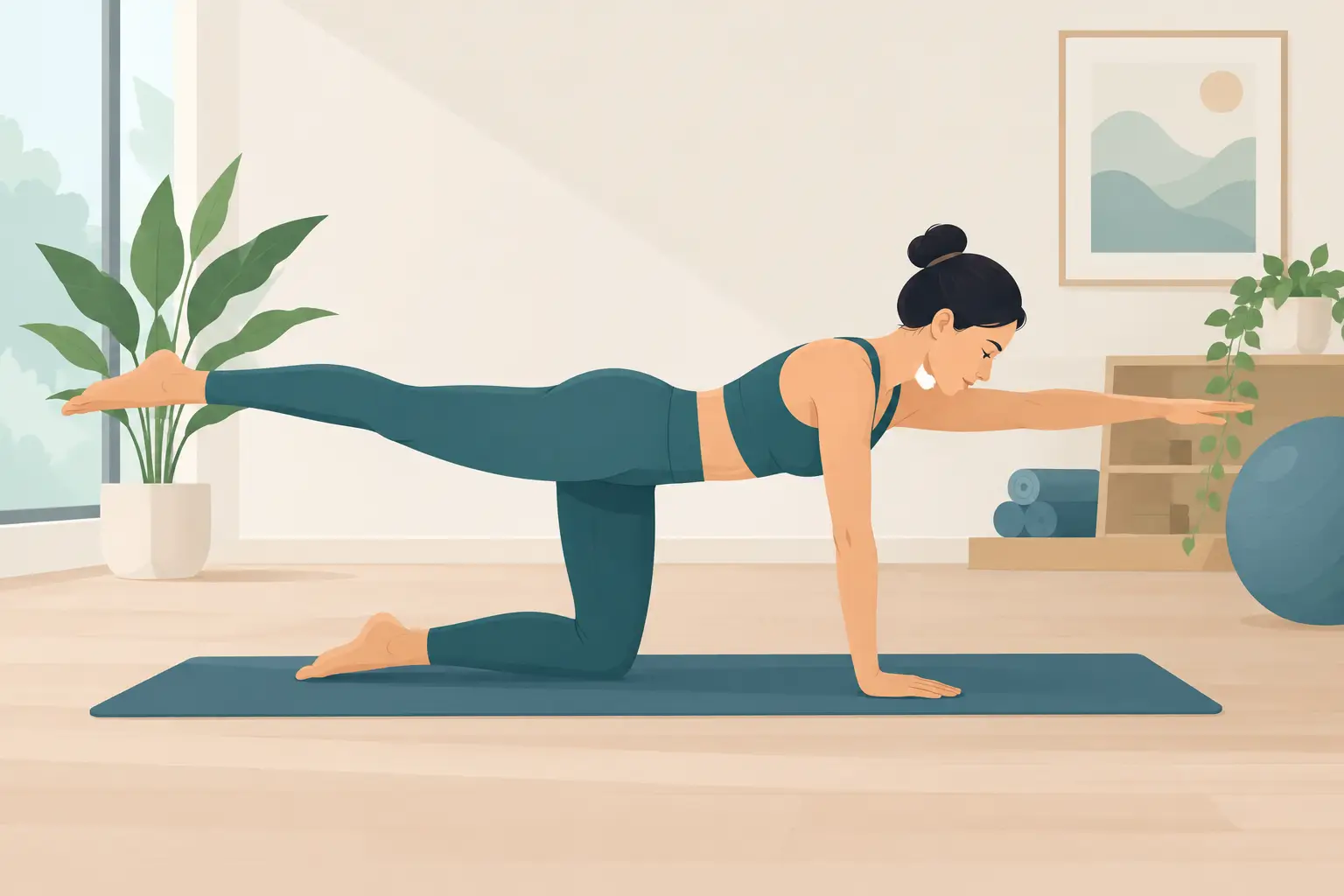
In tabletop, press evenly through both hands and knees without collapsing between the shoulder blades. Keep the back of the neck long, then extend one leg behind you. Before adding the opposite arm, ask whether your pelvis can stay level and your breath can stay calm. This simple variation teaches the trunk to support movement across the body.
In high plank, think less about pulling your navel sharply toward your spine and more about creating one long line from head to heels. Press the floor away, let the upper back stay broad, and use your exhale to maintain a gentle lift through the lower abdomen. Dropping the knees is not a lesser option. It is often the better choice for developing clean form.
Standing poses are equally valuable. Warrior II, crescent lunge, and tree pose ask the feet, hips, and trunk to cooperate. In tree pose, stability does not come from clenching every muscle. It comes from rooting through the standing foot, allowing the breath to move, and making small corrections without frustration.
Include rotation and side-body strength
Life rarely happens straight ahead. We reach into the back seat, carry bags on one side, turn to speak to someone, and change direction quickly. A complete core practice needs to prepare you for rotation and for resisting unwanted rotation.
Side plank variations are especially helpful because they build strength through the obliques, shoulder girdle, and lateral hip. Begin with the lower knee down if needed, and focus on lifting the underside of the waist without holding your breath. A well-supported side plank can be more valuable than a long, shaky hold.
Gentle rotational work can also help. From a lunge or a seated position, rotate through the upper back while keeping the pelvis as steady as is comfortable. The aim is not to force a deeper twist. It is to learn where movement belongs and where support is needed.
A simple weekly approach
Consistency matters more than exhausting yourself once a week. Two or three focused sessions, even 10 to 20 minutes long, can create noticeable changes when the work is progressive and well executed. Pair focused exercises with classes that challenge your control in different ways.
A balanced week may include a Pilates session for precise trunk and hip work, a strength-focused yoga class for weight-bearing positions, and a restorative practice that supports recovery and nervous system regulation. Rest is part of the training process. Muscles need challenge, but your system also needs time to absorb it.
As your control improves, progress one element at a time. You might lengthen a lever by extending the leg farther, reduce your base of support in a balance pose, slow the tempo, or add a light load. Avoid changing everything at once. More intensity is only useful when you can maintain breath and alignment.
Common signs that you need a different approach
Core training should feel challenging, not alarming. Stop and seek individualized guidance if you have sharp pain, persistent back pain, pelvic heaviness or leaking, numbness, dizziness, or symptoms that worsen with exercise. People recovering from pregnancy, surgery, injury, or a period of low activity may need a more tailored starting point.
It also helps to notice patterns that are less dramatic. If your neck tightens during abdominal work, your hip flexors cramp in leg lifts, or you feel your low back doing all the work, do not simply push harder. Adjust the position, shorten the range, or choose a more supported variation. These are useful signals, not failures.
Experienced instruction can make a meaningful difference here. In a smaller class setting, a teacher can help you recognize whether you are over-tucking the pelvis, gripping through the ribs, or avoiding the hips when the movement asks for shared support.
At Breathe Yoga Studio, yoga and Pilates classes offer a supportive place to explore these details with skilled guidance, whether you are building foundations or refining an established practice. For Toronto students balancing busy schedules, regular in-studio practice can also create the accountability that turns good intentions into a sustainable routine.
Your core does not need to be switched on all day. It needs to respond when you need it, then soften when you do not. Begin with patient, breath-led practice, celebrate steadier movement rather than perfect shapes, and let each session become a small vote for a body that feels more capable at home, at work, and on the mat.
