


The first Pilates class can feel surprisingly humbling: a small pelvic tilt may ask more of your attention than a hard workout ever has. That is not a sign you are behind. Learning how to start Pilates safely means giving your body time to understand new patterns, building control before intensity, and choosing instruction that meets you with care.
Pilates is often associated with strong abdominals, long lines, and precise movement. Those benefits are real, but the best place to begin is not by trying to look like the most experienced person in the room. It is by learning how to breathe, align, and move with awareness. A thoughtful start can support strength, mobility, posture, balance, and a more settled relationship with your body.
Start Pilates Safely by Choosing the Right Class
A true beginner Pilates class is usually the most supportive entry point. It gives you room to learn foundational positions, understand the teacher’s cues, and ask questions without feeling rushed. You do not need to be flexible, athletic, or familiar with exercise terminology before you arrive.
Look for a class that clearly welcomes beginners and is led by an experienced instructor. Smaller class settings can be especially helpful because the teacher has more opportunity to notice your form and offer options. If you are returning to movement after a long break, recovering from an injury, managing persistent pain, or pregnant, let the instructor know before class begins. A few details can help them offer a safer variation from the start.
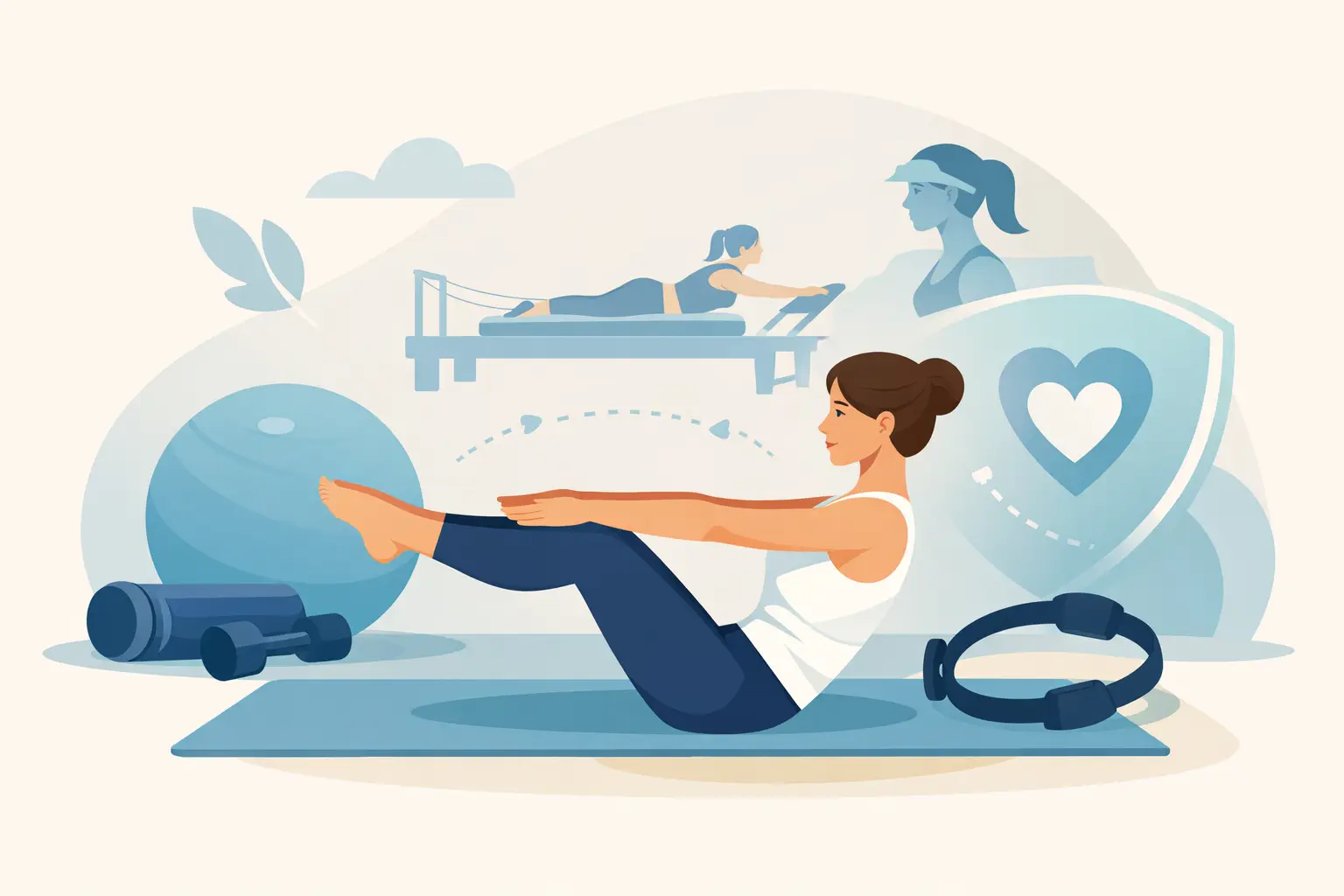
Mat Pilates is often an accessible first step because it uses body weight, gravity, and a small amount of equipment such as bands, balls, or light weights. Reformer Pilates uses a moving carriage and springs to create resistance and support. Neither is automatically better for beginners. A well-taught mat class can build excellent awareness, while a well-supervised reformer class may help some people feel more supported. The right choice depends on your needs, comfort level, and access to knowledgeable instruction.
What Safe Pilates Practice Actually Feels Like
Pilates can be challenging without being punishing. You may feel muscles working in unfamiliar places, particularly through the hips, glutes, back, and deep abdominal wall. You may also notice that concentration is as demanding as the exercises themselves. That is normal.
What you should not feel is sharp, pinching, burning, or escalating pain. A movement that causes pain is not something to push through for the sake of progress. Pause, reduce the range of motion, or choose another option. Your instructor can help distinguish between the effort of strengthening and a signal that your body needs a different approach.
Breath is one of your most useful safety tools. Rather than holding your breath to brace through a difficult exercise, aim for a steady, unforced rhythm. Exhaling through the effort can help you engage your centre without gripping your jaw, shoulders, or pelvic floor. If you cannot breathe smoothly, the exercise may be too intense or too complex for that moment.
Begin with range, not intensity
A smaller movement done with control is often more valuable than a larger movement done with strain. If a leg lift causes your lower back to arch or your shoulders to tense, lower the leg less. If a roll-up makes you pull at your neck, place your hands behind your thighs and practise only the first part of the movement.
This is not taking the easy way out. It is how you teach your nervous system that movement is stable and manageable. Strength develops through repetition and appropriate load, not by forcing your body past its current capacity.
Set Up Your Body Before You Begin
Wear clothes that allow you to move and let the instructor see your alignment. Leggings or comfortable shorts with a fitted top work well. Bare feet are common in mat Pilates, though grip socks can provide extra traction and are often required for equipment-based classes.
Arrive a few minutes early for your first session. This creates space to introduce yourself, mention any relevant injuries or health considerations, and settle into the studio rather than rushing straight onto the mat. You do not need to share your full medical history, but it is useful to mention issues such as recent surgery, osteoporosis, disc concerns, joint replacements, uncontrolled blood pressure, dizziness, or pregnancy.
If you have been advised to avoid certain movements, bring that guidance with you. Pilates is highly adaptable, but adaptations should be specific. A general fitness class is not a substitute for clinical care, physiotherapy, or individual medical advice when you need those supports.
Know when to seek extra guidance
Before starting, speak with a qualified health-care provider if you have a new or unexplained symptom, a recent injury, a significant medical condition, or have been told to limit exercise. This is particularly worthwhile if you experience chest pain, fainting, severe shortness of breath, numbness, or sudden weakness.
During class, stop and ask for help if you notice sharp pain, tingling, joint instability, dizziness, or pain that worsens with each repetition. The goal is not to prove you can tolerate discomfort. The goal is to practise in a way that leaves you feeling more capable over time.
Learn the Foundations Before the Fancy Exercises
Pilates has a vocabulary of its own, but you do not need to memorize it all at once. Your teacher may refer to a neutral spine, imprint, rib positioning, pelvic floor, or the powerhouse. Treat these terms as invitations to explore, not tests you need to pass.
In the beginning, focus on a few essentials: keeping your breath moving, allowing your shoulders to stay away from your ears, noticing the position of your ribs and pelvis, and moving slowly enough to stay aware. This foundation will serve you far more than chasing advanced exercises such as full roll-ups, teasers, or long-lever leg work.
Be cautious with the idea of constantly pulling your navel inward. Effective core engagement is responsive rather than rigid. Your abdominal muscles should support movement while you can still breathe, rotate, and relax when the effort is over. If you feel like you are holding tension all day after class, ask your instructor for a more nuanced cue.
Build a Schedule Your Body Can Trust
One or two Pilates sessions each week is a strong starting point for most beginners. Consistency matters more than doing several demanding classes in your first week and then needing a long recovery. Allow at least a day between sessions at first if you are new to structured exercise or if you are also strength training, running, or playing sport.
Pay attention to how you feel later that day and the next morning. Mild muscle fatigue can be expected, especially after a new type of movement. Lingering pain, severe soreness, or fatigue that disrupts daily life is information worth respecting. You may need less volume, more recovery, or a class level with more foundational work.
Pilates also works beautifully alongside walking, mobility practice, yoga, and strength training. The balance depends on your goals. If you want to improve general movement confidence, Pilates may be your main practice for a while. If you are training for a sport, it can become a focused way to improve control, stability, and recovery between harder sessions.
Let Progress Be Quiet at First
Early progress in Pilates is not always dramatic. You may first notice that you sit taller at your desk, climb stairs with more ease, or recognize when your shoulders are creeping up toward your ears. Those changes matter. They reflect a growing ability to sense and organize your movement.
Avoid judging your practice by how much you sweat or how advanced an exercise appears. A good class should leave you feeling worked, clearer, and more connected to your body, not depleted or intimidated. On some days, the most skillful choice is the gentler variation.
For Toronto beginners looking for a welcoming place to practise, Breathe Yoga Studio offers Pilates in a supportive community setting where experienced teachers can help you establish a strong foundation. Give yourself permission to be new, to ask questions, and to return often enough for the work to become familiar. Safe Pilates begins with that simple kind of trust: listening closely, moving patiently, and allowing strength to grow from there.
