


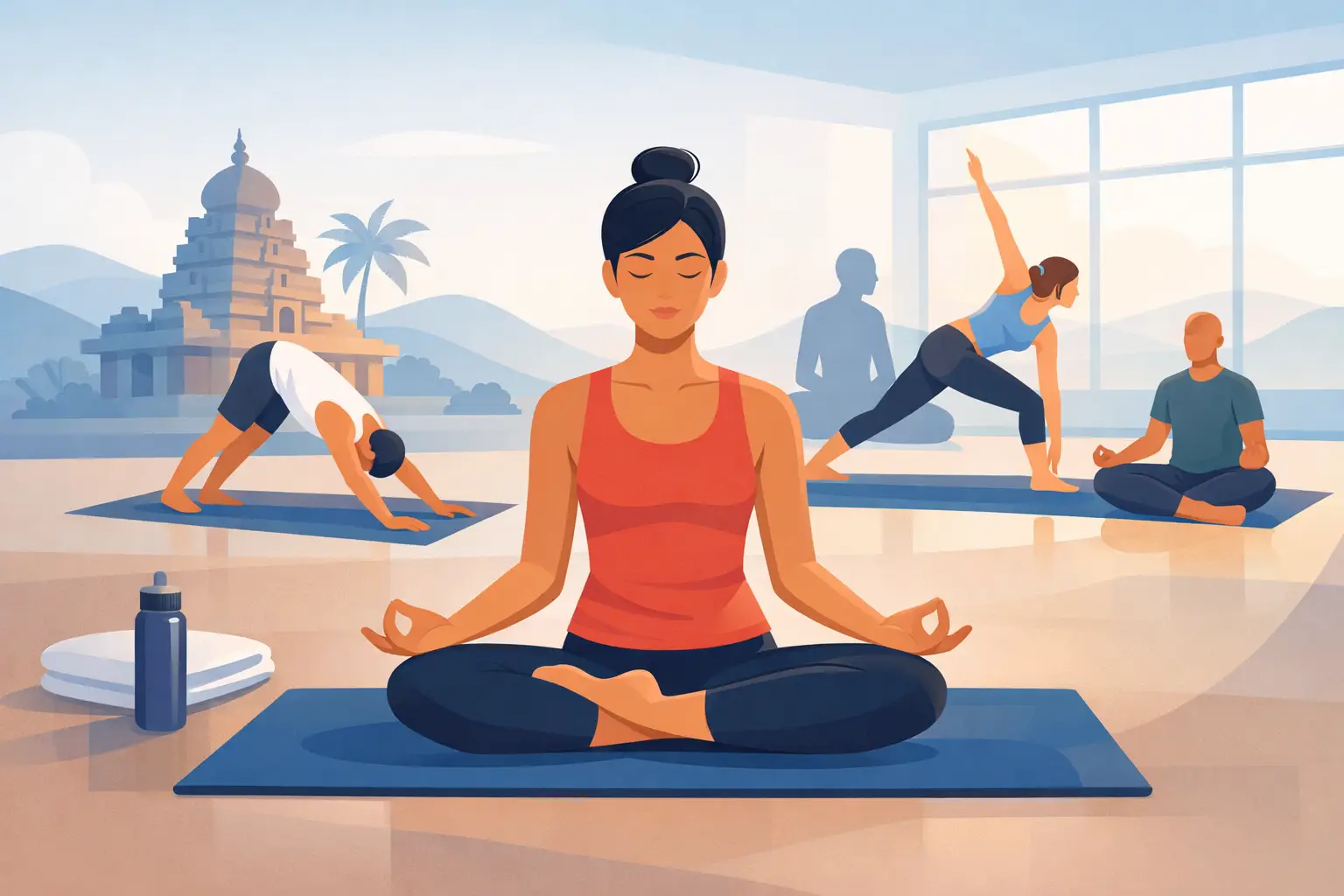
A Mysore room can look surprisingly quiet from the outside. There is no instructor calling out every pose and no group moving in perfect unison. Instead, each student works through a memorized sequence at their own pace while an experienced teacher moves through the room, offering guidance exactly where it is needed. If you have been asking, “what is mysore ashtanga yoga,” this is the essential idea: it is a personalized way of learning a traditional Ashtanga practice within a shared, supportive setting.
For many people, Mysore practice becomes less about keeping up and more about paying attention. You build strength, mobility, focus, and confidence over time, with room to meet your body honestly on any given day.
What Is Mysore Ashtanga Yoga?
Mysore Ashtanga yoga is the traditional method for learning Ashtanga Vinyasa Yoga. It takes its name from Mysore, India, where this style was taught and developed by Sri K. Pattabhi Jois. Rather than following a teacher-led class from beginning to end, students practise a set sequence independently, receiving one-to-one instruction, hands-on support when appropriate, and modifications from the teacher.
Ashtanga Vinyasa Yoga is built around a linked system of breath and movement. The practice includes postures arranged in a specific order, with vinyasas, or transitions, connecting many of them. A student usually begins with the opening portion of the Primary Series and gradually learns more as their breath, steadiness, and understanding develop.
“Mysore style” does not mean being left alone to figure it out. It means the teaching is individualized. A newer student may be learning a few foundational postures and finishing in 30 minutes. Someone with an established practice may move through a longer sequence over 75 or 90 minutes. Both can practise in the same room, supported by the same teacher.
How a Mysore Practice Feels in the Room
A Mysore class has a gentle rhythm of its own. Students arrive within a designated practice window rather than at one fixed start time. After a brief check-in, you begin your practice. The room is often quiet except for breathing, the soft sound of movement, and occasional conversation between teacher and student.
This setting can feel unfamiliar if you are used to flow classes, where everyone follows the same verbal cues. Yet the absence of constant instruction is part of the learning. You start to recognize your breathing pattern, remember the order of the poses, and notice when your mind wants to rush ahead or pull away.
The teacher is actively present throughout. They may remind you of the next posture, help you establish a safer hand position, suggest a prop, offer a variation, or invite you to pause. With consent, some teachers may use hands-on assists. Clear communication matters, and you should always feel welcome to state your preferences, boundaries, injuries, or concerns.
Because everyone is practising at a different point in the sequence, Mysore can be both focused and communal. You are not performing for the room. You are practising alongside others who are also learning how to be present in their own bodies.
The role of breath and repetition
Ashtanga practice uses ujjayi breathing, a steady, audible breath that helps create internal warmth and gives the mind something concrete to return to. Each inhale and exhale helps organize the movement. The aim is not to force a dramatic sound or push through discomfort. It is to create a breath that remains smooth enough to guide the practice.
Repetition is another defining feature. Returning to the same sequence allows you to see change clearly. A posture that once felt inaccessible may become familiar. A shape that felt easy may reveal new layers of strength or attention. This consistency can be deeply grounding, particularly for people whose work and home lives ask them to switch tasks all day.
Is Mysore Ashtanga Yoga Only for Advanced Students?
No. Mysore is often one of the most supportive ways for beginners to learn Ashtanga because the practice is taught in manageable pieces. You do not need to memorize a full series before you arrive, nor do you need to be flexible, strong, or able to perform advanced postures.
A skilled teacher meets you with the practice that makes sense for your body today. For one person, that may mean sun salutations, standing poses, and a simple closing sequence. For another, it may mean modifying weight-bearing positions due to wrist sensitivity or using a more restorative approach while recovering from illness, injury, or a demanding season of life.
There is a common misconception that Ashtanga must be intense every day. While it can be physically demanding, intelligent practice includes discernment. Sleep, stress, menstrual cycles, injury history, pregnancy, energy levels, and mental health can all influence what is appropriate. A sustainable Mysore practice is not a test of willpower. It is a relationship with your breath, body, and capacity.
That said, Mysore may not be the best first fit for everyone. If you prefer frequent verbal instruction or feel anxious without a group-led pace, a beginner yoga class can offer a reassuring introduction to foundational alignment and breath. Many students enjoy both formats. A led class can reinforce rhythm and sequence, while Mysore offers individualized attention and space to practise independently.
What You Will Learn Over Time
Mysore practice builds more than a list of yoga poses. It teaches you how to arrive, warm up, work with challenge, and close your practice with care. At first, remembering the order may be the main focus. Soon, you may notice that the sequence becomes a reliable framework for self-awareness.
With regular attendance, students commonly develop stronger shoulders, legs, and core stability, as well as greater mobility in the hips, hamstrings, and spine. The benefits are not identical for everyone, and flexibility is not the sole measure of progress. Better body awareness, calmer breathing, improved concentration, and a more consistent movement habit can be just as meaningful.
The format also encourages appropriate autonomy. You learn what a productive effort feels like and what signals you need to respect. That knowledge can support other parts of life, from how you sit at a desk to how you recover after a busy week.
How to Prepare for Your First Mysore Class
Come with curiosity rather than expectations. Wear clothing that lets you move comfortably, and avoid a heavy meal for a couple of hours before practice if possible. Arrive early enough to speak with the teacher, especially if you are new to yoga, returning after a break, managing an injury, or pregnant.
Tell the teacher about anything that may affect your practice. This includes wrist, shoulder, knee, back, or hip concerns, as well as dizziness, high blood pressure, recent surgery, or other health considerations. Yoga instruction can be thoughtfully adapted, but only when your teacher has the information they need.
You do not need to bring a performance mindset into the room. Your first class may involve learning just a few movements, pausing often, and asking questions. That is exactly how the method works. Consistency matters far more than completing a long sequence quickly.
It can also help to choose a realistic rhythm. Two shorter practices each week may be more nourishing than trying to fit in five and burning out. As your confidence grows, you can adjust. The best schedule is one that supports your energy, responsibilities, and recovery.
A Practice That Grows With You
Mysore Ashtanga yoga offers structure without requiring every practitioner to fit the same mould. The sequence remains steady, but the teaching responds to the individual. That balance is why the method can serve both a person taking their first steps into yoga and a dedicated student refining a long-term practice.
At Breathe Yoga Studio in Toronto’s Junction, Mysore practice is held as a focused community experience: a place to receive experienced guidance while building trust in your own capacity. If you are curious, begin with one class, speak openly with the teacher, and let the practice unfold at a pace that feels sustainable for you.
