


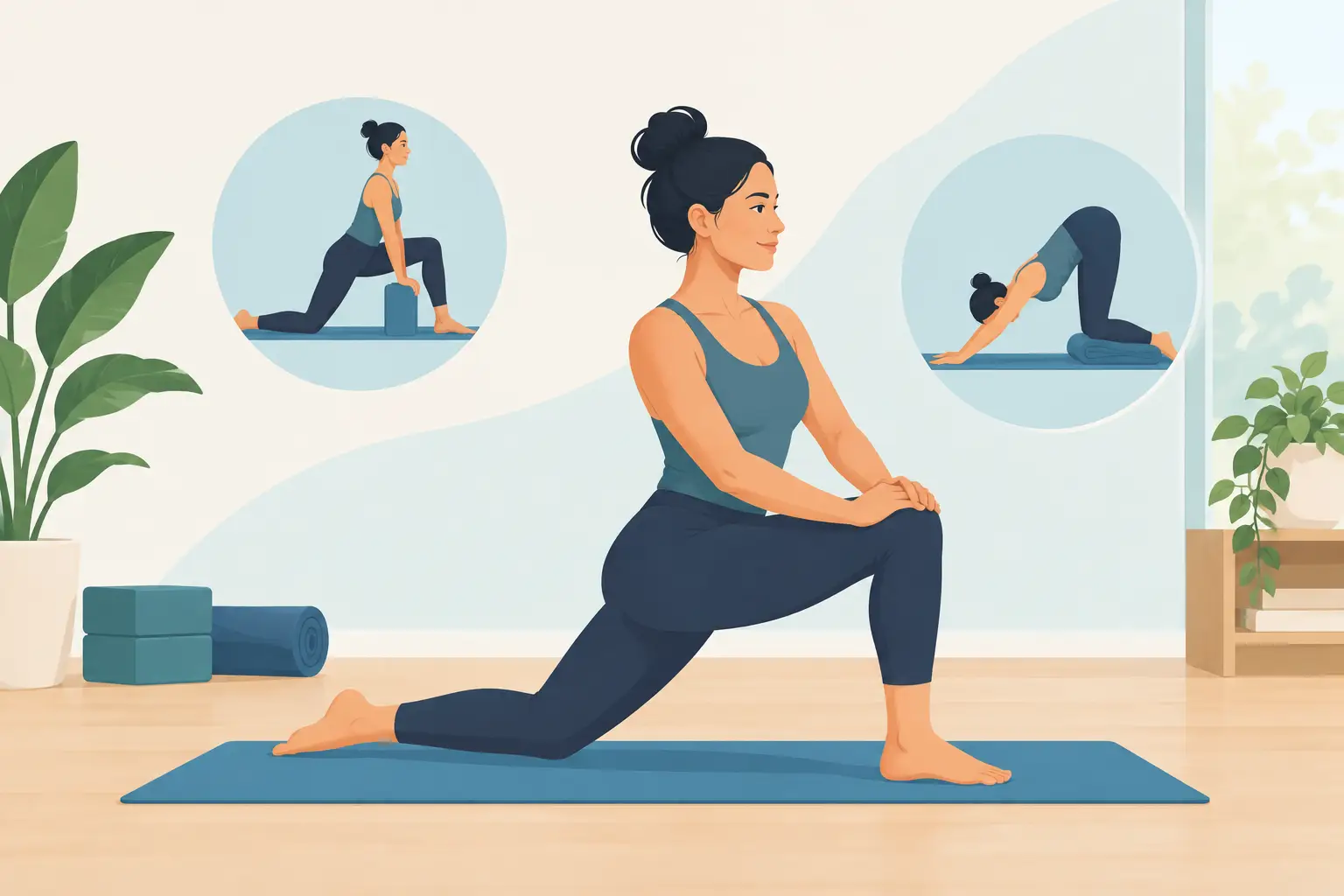
A pose can look entirely different from one body to the next, even in the same room. Learning how to modify yoga poses is not about making a practice easier or opting out of challenge. It is about choosing a version of the shape that lets you breathe steadily, feel the intended work, and leave class more connected to your body than when you arrived.
At Breathe Yoga Studio, we see modifications as a practical expression of self-awareness. Some days call for more strength, while others call for support, recovery, or a smaller range of motion. A thoughtful adjustment can make yoga more sustainable, whether you are new to the mat, returning after time away, managing stiffness from desk work, or deepening a long-standing practice.
Start with the purpose of the pose
Before changing a pose, ask what it is meant to offer. Is the intention to build leg strength, lengthen the back body, create spinal rotation, open the chest, or settle the nervous system? Once you understand the purpose, you can adapt the pose without losing its value.
Take Downward-Facing Dog. It may be taught as a full-body shape that strengthens the arms and shoulders while lengthening the spine and backs of the legs. If your hamstrings are tight, deeply straight legs can pull the pelvis under and round the low back. Bending both knees gives the spine more space to lengthen. The pose still does its job, perhaps better for your body that day.
This is the guiding principle: preserve the sensation and intention, not a picture-perfect outline. Your range of motion, proportions, energy level, and physical history all matter.
How to modify yoga poses without losing alignment
A useful modification usually changes one variable at a time. You might reduce depth, widen your stance, add height from the floor, use a prop, or choose a related pose. Changing everything at once can make it difficult to tell what is helping.
Reduce the range before changing the whole pose
Less depth is often the most effective first choice. In a forward fold, bend your knees enough that your torso can rest closer to your thighs. In Warrior II, shorten the stance or bend the front knee less deeply. In a twist, rotate only to the point where your breath remains smooth and your shoulders stay relaxed.
A smaller range is not a watered-down version of yoga. It can help you build strength, control, and body awareness without forcing a joint beyond its current capacity. Over time, consistent practice may naturally change your range, but that is a result rather than a requirement.
Bring the floor closer to you
Many poses become more accessible when you raise the ground. Blocks beneath the hands in a lunge, standing forward fold, or Triangle Pose can reduce strain in the low back and shoulders. Sitting on a folded blanket in a seated posture can help the pelvis tip forward, making it easier to sit tall rather than collapsing through the spine.
A chair and a wall can be equally valuable. Chair-supported Chair Pose allows you to practise the hip and knee action while gaining confidence in balance. A wall can support your hands in a modified Plank, offer feedback in standing poses, or give your legs a place to rest in a restorative shape. Props are not signs that you are behind. They are tools that offer useful feedback and make a pose fit your body.
Change the leverage when strength is the limit
When a pose asks for more strength than you have available, adjust the lever rather than holding your breath to stay in it. In Plank Pose, place your knees down while keeping a long line from the head through the hips. In Chaturanga, lower the knees first or move directly from Plank to the floor with control. In Side Plank, keep the lower knee grounded.
These choices allow you to practise shoulder stability and core engagement without sacrificing alignment. As strength develops, you can gradually explore a fuller variation. The right progression is the one you can repeat with steadiness.
Let your breath decide the depth
Breath is one of the clearest signals in a yoga practice. If you are gripping your jaw, holding your breath, or rushing to escape a pose, that is useful information. It may mean the shape is too intense, your nervous system needs more support, or you need a different transition.
Try using a simple check: can you take three slow, even breaths in this version of the pose? If the answer is no, back out slightly. You might bend your knees, take your hands to blocks, lower one knee, or come into a more supported option.
This does not mean every pose should feel effortless. Healthy effort can be clear, focused, and energizing. Sharp pain, pinching, numbness, dizziness, or a sensation of instability are different. Come out of the pose and speak with your teacher. If symptoms are persistent, new, or related to an injury, seek guidance from an appropriate regulated health professional before pushing forward.
Common modifications for everyday bodies
Wrist discomfort, sensitive knees, tight hips, and a stiff low back are common reasons to adapt a practice. The best choice depends on the cause, so avoid assuming one modification works for everyone. Still, a few approaches are broadly helpful.
For wrists, reduce the amount of weight bearing. Practise Plank with hands at a wall or on a chair, take forearm variations when appropriate, and spread weight through the whole hand rather than collapsing into the heel of the palm. In tabletop, placing a folded edge of a mat under the heel of the hand can reduce the wrist angle for some students.
For knees, add cushioning with a folded blanket and make sure the knee tracks in the same direction as the toes in lunges and standing poses. In kneeling postures, extra padding may help, but persistent pain should not be covered up with more cushioning alone. Choose a non-kneeling variation if the joint remains uncomfortable.
For hips and low backs, height is often helpful. Sit on a blanket for cross-legged shapes, place blocks under the knees in supported reclined poses, and avoid forcing external rotation in poses such as Pigeon. A reclined Figure Four may offer a more manageable way to explore a similar hip-opening sensation. It may also be wiser to skip deep stretching on days when the area feels irritated or unstable.
For balance, use the wall without apology. In Tree Pose, one hand can rest lightly on the wall while you focus on your standing foot, breath, and upright posture. Balance is a skill built through repetition, not a test of whether you can stand still on command.
Match modifications to the style of class
The pace and intention of class affect which adaptations make sense. In a dynamic flow, a quick, repeatable option may be best: knees down in Plank, blocks at the front of the mat, or a shorter stance. In a strength-focused class, you may choose a variation that still creates meaningful muscular effort while protecting a vulnerable area.
In restorative yoga, the goal is often down-regulation and supported rest. More props can be the point. Bolsters, blankets, blocks, and careful positioning allow the body to settle rather than work to hold itself up. In Mysore or Ashtanga practice, modifications may be more individualized and progress slowly as your teacher observes your movement, breath, and consistency.
Pregnancy, hypermobility, recent surgery, and chronic conditions deserve especially personalized support. There is no universal prenatal or injury modification. What is appropriate can change by trimester, diagnosis, symptoms, medical guidance, and prior movement experience. A skilled teacher can help you find an option, but clear communication about your needs matters too.
Speak to your teacher before class
You do not need to share your full medical history at the front desk. A short, specific note is often enough: “My right shoulder is sensitive in weight-bearing poses,” or “I am returning after a knee flare-up and may need options.” Arrive a few minutes early when possible so your teacher can offer practical choices without interrupting the flow of class.
During class, give yourself permission to take the variation that was offered even if no one else does. You can also rest in Child’s Pose, take a neutral position, or simply watch a transition before trying it. Yoga is a practice of attention, and choosing wisely is part of the work.
Build a practice that can stay with you
The most supportive modification is sometimes the one that helps you return tomorrow. Rather than measuring progress by how far you can stretch or how advanced a pose looks, notice whether your breath is calmer, your joints feel more reliable, or you recover more easily after movement.
Bring curiosity to the next pose that challenges you. Try one small adjustment, pause long enough to feel its effect, and let your body be the source of the answer. That patient conversation with yourself is where a yoga practice becomes a lasting sanctuary.
