


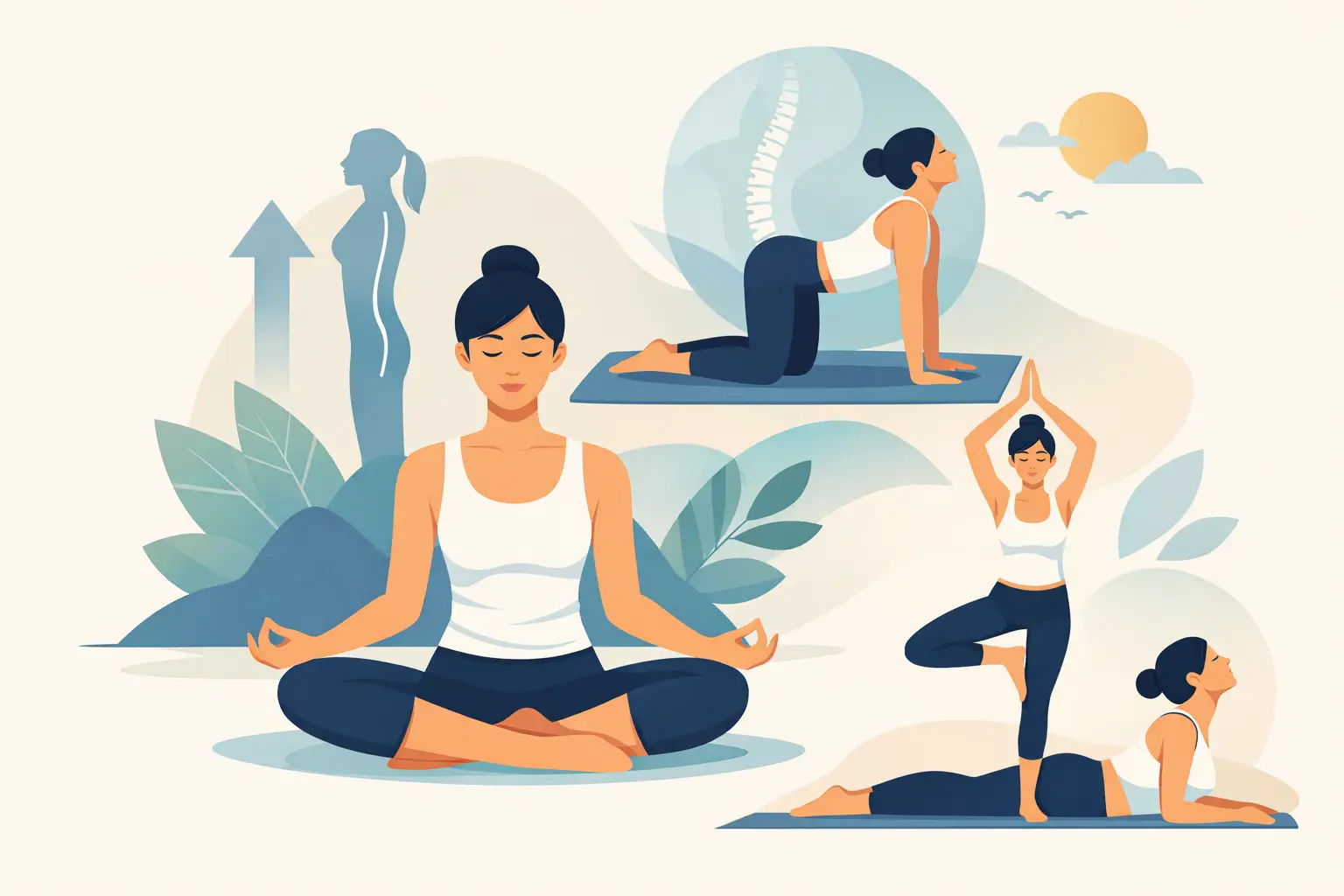
Your posture is not a test you pass by pulling your shoulders back all day. It is a moving relationship between your breath, strength, mobility, habits, and nervous system. The best yoga poses for posture help you practise that relationship with more awareness, rather than forcing your body into a rigid position that cannot last.
For many of us, posture discomfort starts quietly: a tight neck after laptop work, rounded shoulders while commuting, an achy low back after standing, or a sense that it is difficult to take a full breath. Yoga can be a supportive answer because it builds both mobility and control. The goal is not a military-straight spine. It is a body that can stack, bend, rotate, and return to a comfortable upright position with less effort.
What better posture actually asks of your body
A postural practice needs more than chest-opening stretches. If the upper back is weak, the chest may round again moments after a stretch. If hips are very tight, the low back may compensate. If you are stressed and breathing shallowly, even excellent alignment cues can feel impossible to maintain.
A balanced yoga sequence therefore combines gentle opening through the chest, shoulders, hips, and front body with strength in the back, core, glutes, and legs. It also invites slower breathing, which can reduce the bracing patterns that keep shoulders hovering near the ears.
Pain, numbness, persistent headaches, or symptoms that travel into an arm or leg deserve assessment from a qualified health professional. Yoga can be a valuable part of movement care, but it should not ask you to push through sharp or worsening pain.
The best yoga poses for posture
Move slowly through these poses and use props without hesitation. A folded blanket, block, wall, or chair can make the work more precise and more comfortable. Three to five steady breaths in each shape is a useful starting point. On days when you have more time, repeat the sequence once or twice.
1. Mountain Pose
Mountain Pose may look like simply standing, but it teaches the foundation of balanced alignment. Stand with your feet hip-width apart or closer together if that feels natural. Feel the pressure under your heels, big-toe mounds, and little-toe mounds. Let your knees stay soft, lengthen through the crown of your head, and allow your ribs to settle over your pelvis.
Rather than yanking your shoulders back, broaden across the collarbones and let the arms rest easily. Notice whether you are holding your breath. A quiet inhale and longer exhale can help the body find a less effortful upright position.
2. Cat-Cow
Cat-Cow brings movement to a spine that may have spent hours in one position. Begin on hands and knees with wrists under shoulders and knees under hips. On an inhale, tip the pelvis, gently lift the chest, and lengthen the front of the body. On an exhale, press the floor away, round through the upper back, and let the head follow naturally.
The value here is not creating the largest possible arch or curve. It is learning to distribute movement through the whole spine, especially the often-stiff upper back. If your wrists are sensitive, practise with your hands on a wall, a countertop, or the seat of a chair.
3. Low Lunge
Long periods of sitting can leave the fronts of the hips feeling short and the glutes less available. Low Lunge offers space at the hip flexors while asking the legs to support the pelvis. Step one foot forward from hands and knees, lower the back knee to a blanket, and keep the front knee roughly over the ankle.
Before moving forward, gently draw the low belly in and imagine lengthening the tailbone toward the floor. Then shift forward only enough to feel a moderate stretch through the front of the back hip. Keep your chest broad rather than collapsing into the low back. Repeat on the other side.
4. Sphinx Pose
Sphinx Pose is a calm way to build tolerance for gentle back extension, which can feel particularly welcome after a rounded desk posture. Lie on your belly and place your elbows beneath or slightly ahead of your shoulders. Press lightly through your forearms, lengthen your legs behind you, and lift your chest without squeezing your shoulder blades aggressively together.
Think of drawing the sternum forward, not simply upward. Your neck should feel long and easy. If there is pinching in the low back, bring the elbows farther forward, lower the chest, or skip this pose for now. More height is not more benefit.
5. Locust Pose
Locust Pose strengthens the muscles along the back body, including the upper back, spinal extensors, glutes, and hamstrings. Lie on your belly with arms alongside your body. On an inhale, lift your head, chest, and arms a few centimetres, keeping the gaze slightly forward and down so the back of the neck stays long.
Lift from the strength of your upper back rather than throwing the shoulders toward your ears. Your legs can remain on the floor, especially at first. This is a small but potent posture, and two or three short rounds are often more useful than one long, strained hold.
6. Bridge Pose
Bridge Pose gives the back body a different kind of support. Lie on your back with knees bent and feet on the floor, about hip-width apart. Press evenly through both feet and lift your hips on an exhale. Keep the knees pointing forward and let the ribs stay soft instead of flaring upward.
This pose can strengthen glutes and hamstrings while opening the front of the hips. If your neck feels compressed, lower down and place a folded blanket beneath your shoulders, leaving your head on the floor. Avoid turning your head once you are lifted.
7. Thread the Needle
Rounded shoulders are not always solved by stretching harder, but gentle shoulder mobility can make reaching, breathing, and sitting more comfortable. From hands and knees, slide your right arm underneath your left arm, turning your palm up. Rest your right shoulder and temple on the mat if they reach comfortably.
Keep some weight in the supporting hand and breathe into the back of the ribs. The sensation should be spacious, not sharp at the shoulder. A block or cushion beneath the shoulder can bring the floor closer. Stay for several breaths, then change sides.
8. Supported Fish Pose
Supported Fish Pose is a restorative chest opener that can help counter the feeling of folding inward without demanding a deep backbend. Place a yoga block on its medium or low height beneath the upper back, just below the shoulder blades. You may use another low block, blanket, or cushion beneath the head. Recline and allow the arms to rest out to the sides.
The support should make breathing easier. If your chin tips high or your low back feels strained, add height beneath the head or lower the support under the upper back. Remain for one to three minutes, breathing slowly through the ribs and chest.
Build a posture practice you will actually repeat
Consistency matters more than a perfect 30-minute sequence. A five-minute reset after work can be meaningful: Mountain Pose to notice your stance, a few rounds of Cat-Cow, Low Lunge on each side, Locust Pose, and a minute of Supported Fish. On another day, a strength-focused yoga or Pilates class may be the better choice, particularly if you want more guidance building core and posterior-chain strength.
It also helps to bring yoga principles into ordinary moments. Raise your screen when possible. Change positions regularly instead of trying to sit perfectly for hours. Let your feet support you while waiting for the kettle. Take a slower exhale before responding to a stressful message. Posture is shaped by the many positions you inhabit, not just the time you spend on a mat.
In a well-taught class, an experienced instructor can help you distinguish between a useful sensation and compensation, then offer options that respect your body on that day. At Breathe Yoga Studio in Toronto’s Junction, small-class attention can make that exploration feel less like correction and more like a steady return to yourself.
The most supportive posture is one you can breathe in. Give your body frequent opportunities to move, rest, and build strength, and standing taller may become a welcome side effect rather than another demand on your day.
